Site Content

1. CALIBRATION STARTS WITH THE SYSTEM
An accurate belt weigher calibration starts with ensuring that the weighing system is mechanically and electrically sound. Before adjusting the zero or span settings, BAMAU conducts thorough checks on the controller configuration, mechanical condition, load cells, roller alignment, and belt speed measurement, as well as evaluating field dimensions. This meticulous process validates whether the system can deliver stable and repeatable results, which are essential for effective calibration services. Additionally, for optimal performance, tramp metal detector calibration should be factored into the overall maintenance strategy.
2. ZERO BEFORE SPAN
A belt weigher can accurately measure a known calibration weight during belt weigher calibration; however, it may still produce inaccurate production results if the empty-belt zero is unstable. Issues such as poor belt contact, roller misalignment, load-cell imbalance, build-up, or mechanical interference can all affect the zero reading. Identifying these conditions is crucial before initiating span adjustments, particularly when evaluating calibration services or preparing for tramp metal detector calibration.
3. VERIFY THE PHYSICAL SYSTEM
The dimensions and parameters entered into the controller must match the actual conveyor installation. As part of its belt weigher calibration process, BAMAU verifies the weigh area, idler spacing, belt length, speed measurement, and load-cell configuration against the physical equipment in the field. Before relying on the controller calculation, it also ensures that all necessary calibration services, including tramp metal detector calibration, are correctly implemented.
4. CALIBRATION METHODS
Depending on the application, BAMAU can provide calibration services that ensure accurate belt weigher calibration using material verification, certified static test weights, and SIP calibration weights. While calibration chains can be supported if necessary, our preferred method involves using a stable weighing system calibrated against a known, repeatable reference. We generally avoid calibration chains to minimize additional handling and safety risks, especially in environments where tramp metal detector calibration may be required.
5. VERIFY THE COMPLETE MEASUREMENT CHAIN
Calibration does not stop at the belt weigher controller. BAMAU guarantees comprehensive belt weigher calibration by verifying the final measurement all the way to the PLC, DCS, or control room. This process includes monitoring feed-rate signals, 4–20 mA scaling, communications, and totaliser operation where relevant. Our calibration services also encompass tramp metal detector calibration, ensuring that every aspect is rigorously checked.
BAMAU BELT WEIGHER CALIBRATION PROCESS

An accurate belt weigher calibration starts with ensuring that the weighing system is mechanically and electrically sound. Before adjusting the zero or span settings, BAMAU conducts thorough checks on the controller configuration, mechanical condition, load cells, roller alignment, and belt speed measurement, as well as evaluating field dimensions. This meticulous process validates whether the system can deliver stable and repeatable results, which are essential for effective calibration services. Additionally, for optimal performance, tramp metal detector calibration should be factored into the overall maintenance strategy.
1. CONTROLLER & CONFIGURATION CHECK
A belt weigher can accurately measure a known calibration weight during belt weigher calibration; however, it may still produce inaccurate production results if the empty-belt zero is unstable. Issues such as poor belt contact, roller misalignment, load-cell imbalance, build-up, or mechanical interference can all affect the zero reading. Identifying these conditions is crucial before initiating span adjustments, particularly when evaluating calibration services or preparing for tramp metal detector calibration.
2. MECHANICAL INSPECTION
The dimensions and parameters entered into the controller must match the actual conveyor installation. As part of its belt weigher calibration process, BAMAU verifies the weigh area, idler spacing, belt length, speed measurement, and load-cell configuration against the physical equipment in the field. Before relying on the controller calculation, it also ensures that all necessary calibration services, including tramp metal detector calibration, are correctly implemented.
3. LOAD-CELL CHECK & BALANCE
Depending on the application, BAMAU can provide calibration services that ensure accurate belt weigher calibration using material verification, certified static test weights, and SIP calibration weights. While calibration chains can be supported if necessary, our preferred method involves using a stable weighing system calibrated against a known, repeatable reference. We generally avoid calibration chains to minimize additional handling and safety risks, especially in environments where tramp metal detector calibration may be required.
4. ROLLER ALIGNMENT & IDLER SPACING
Calibration does not stop at the belt weigher controller. BAMAU guarantees comprehensive belt weigher calibration by verifying the final measurement all the way to the PLC, DCS, or control room. This process includes monitoring feed-rate signals, 4–20 mA scaling, communications, and totaliser operation where relevant. Our calibration services also encompass tramp metal detector calibration, ensuring that every aspect is rigorously checked.
5. BELT SPEED & BELT LENGTH
The conveyor is operated, and the actual belt speed and belt length are verified as part of the belt weigher calibration process. During this inspection, the speed sensor is thoroughly checked, and its configuration is confirmed to ensure the correct number of pulses is generated and interpreted for each revolution or measured distance. Furthermore, as part of our comprehensive calibration services, tramp metal detector calibration may also be performed as necessary to ensure optimal performance.

6. RUNNING LOAD-CELL & ZERO CHECKS
A belt weigher can accurately measure a known calibration weight during belt weigher calibration; however, it may still produce inaccurate production results if the empty-belt zero is unstable. Issues such as poor belt contact, roller misalignment, load-cell imbalance, build-up, or mechanical interference can all affect the zero reading. Identifying these conditions is crucial before initiating span adjustments, particularly when evaluating calibration services or preparing for tramp metal detector calibration.
7. ZERO STABILITY & REPEATABILITY
The dimensions and parameters entered into the controller must match the actual conveyor installation. As part of its belt weigher calibration process, BAMAU verifies the weigh area, idler spacing, belt length, speed measurement, and load-cell configuration against the physical equipment in the field. Before relying on the controller calculation, it also ensures that all necessary calibration services, including tramp metal detector calibration, are correctly implemented.
8. EXPECTED SPAN CALCULATION & VERIFICATION
Depending on the application, BAMAU can provide calibration services that ensure accurate belt weigher calibration using material verification, certified static test weights, and SIP calibration weights. While calibration chains can be supported if necessary, our preferred method involves using a stable weighing system calibrated against a known, repeatable reference. We generally avoid calibration chains to minimize additional handling and safety risks, especially in environments where tramp metal detector calibration may be required.
9. CONTROL SYSTEM / 4–20 mA VERIFICATION
Calibration does not stop at the belt weigher controller. BAMAU guarantees comprehensive belt weigher calibration by verifying the final measurement all the way to the PLC, DCS, or control room. This process includes monitoring feed-rate signals, 4–20 mA scaling, communications, and totaliser operation where relevant. Our calibration services also encompass tramp metal detector calibration, ensuring that every aspect is rigorously checked.
10. TOTALISER & COMMUNICATIONS CHECK
The conveyor is operated, and the actual belt speed and belt length are verified as part of the belt weigher calibration process. During this inspection, the speed sensor is thoroughly checked, and its configuration is confirmed to ensure the correct number of pulses is generated and interpreted for each revolution or measured distance. Furthermore, as part of our comprehensive calibration services, tramp metal detector calibration may also be performed as necessary to ensure optimal performance.
TRAMP METAL DETECTOR TESTING & OPTIMISATION
1. INSTALLATION & COIL CONDITION
A belt weigher can accurately measure a known calibration weight during belt weigher calibration; however, it may still produce inaccurate production results if the empty-belt zero is unstable. Issues such as poor belt contact, roller misalignment, load-cell imbalance, build-up, or mechanical interference can all affect the zero reading. Identifying these conditions is crucial before initiating span adjustments, particularly when evaluating calibration services or preparing for tramp metal detector calibration.
2. CONTROLLER & COIL BALANCE
The dimensions and parameters entered into the controller must match the actual conveyor installation. As part of its belt weigher calibration process, BAMAU verifies the weigh area, idler spacing, belt length, speed measurement, and load-cell configuration against the physical equipment in the field. Before relying on the controller calculation, it also ensures that all necessary calibration services, including tramp metal detector calibration, are correctly implemented.
3. CONVEYOR RUNNING TEST
Depending on the application, BAMAU can provide calibration services that ensure accurate belt weigher calibration using material verification, certified static test weights, and SIP calibration weights. While calibration chains can be supported if necessary, our preferred method involves using a stable weighing system calibrated against a known, repeatable reference. We generally avoid calibration chains to minimize additional handling and safety risks, especially in environments where tramp metal detector calibration may be required.
4. SENSITIVITY & DETECTION TESTING
Calibration does not stop at the belt weigher controller. BAMAU guarantees comprehensive belt weigher calibration by verifying the final measurement all the way to the PLC, DCS, or control room. This process includes monitoring feed-rate signals, 4–20 mA scaling, communications, and totaliser operation where relevant. Our calibration services also encompass tramp metal detector calibration, ensuring that every aspect is rigorously checked.
5. OUTPUTS, ALARMS & CONTROL SYSTEM
The conveyor is operated, and the actual belt speed and belt length are verified as part of the belt weigher calibration process. During this inspection, the speed sensor is thoroughly checked, and its configuration is confirmed to ensure the correct number of pulses is generated and interpreted for each revolution or measured distance. Furthermore, as part of our comprehensive calibration services, tramp metal detector calibration may also be performed as necessary to ensure optimal performance.
Getting Results

BAMAU FLAG-DROP ASSEMBLY
PROVING THE DETECTION SYSTEM
PROVING THE DETECTION SYSTEM
BAMAU GROUP offers expert belt weigher calibration services, specializing in the calibration of belt weighers, weightometers, and conveyor belt scales throughout Australian mining and bulk materials handling operations.
Our thorough calibration services assess the entire weighing system, paying attention to essential factors such as weig
BAMAU GROUP offers expert belt weigher calibration services, specializing in the calibration of belt weighers, weightometers, and conveyor belt scales throughout Australian mining and bulk materials handling operations.
Our thorough calibration services assess the entire weighing system, paying attention to essential factors such as weigh-frame condition, roller alignment, load-cell balance, belt contact, speed measurement, zero stability, and controller configuration before finalizing the zero and span calibration.
We support all leading brands of belt weighers and can provide calibration services, fault finding, and corrective maintenance all in one site visit, ensuring your operations continue to run efficiently. Furthermore, we also offer tramp metal detector calibration to improve the accuracy and reliability of your systems.
PROVING THE DETECTION SYSTEM
PROVING THE DETECTION SYSTEM
PROVING THE DETECTION SYSTEM
BAMAU GROUP specializes in testing, fault finding, and optimisation of tramp metal detectors used on mining conveyors, including tramp metal detector calibration. We conduct thorough investigations into factors such as sensitivity, false trips, coil balance, electrical interference, installation geometry, and detector configuration to enh
BAMAU GROUP specializes in testing, fault finding, and optimisation of tramp metal detectors used on mining conveyors, including tramp metal detector calibration. We conduct thorough investigations into factors such as sensitivity, false trips, coil balance, electrical interference, installation geometry, and detector configuration to enhance the reliable detection performance. In addition to our tramp metal detector calibration services, we also offer comprehensive calibration services for belt weighers, ensuring optimal performance across Barrier, Oretronic, and other tramp metal detection systems, including performance testing, commissioning, and upgrade recommendations.
DUAL ORETRONIC REDUNDANCY
BARRIER — NEXT-GENERATION DETECTION
BARRIER — NEXT-GENERATION DETECTION
The dual detector configuration is employed to enhance redundancy and distinguish between genuine tramp metal events and false trips from individual detectors. This approach ensures precise belt weigher calibration and supports effective calibration services, including tramp metal detector calibration.
BARRIER — NEXT-GENERATION DETECTION
BARRIER — NEXT-GENERATION DETECTION
BARRIER — NEXT-GENERATION DETECTION
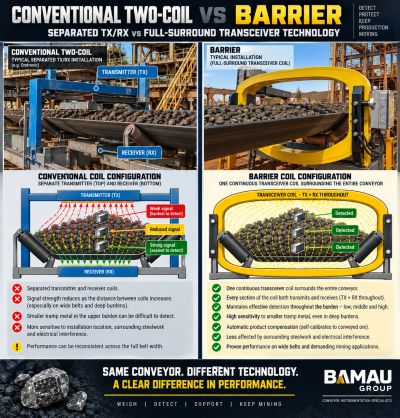
Our full-surround transceiver technology is engineered for high sensitivity and stability, crucial for false-trip resistance on demanding mining conveyors. This technology is particularly suitable for applications such as belt weigher calibration and tramp metal detector calibration, all supported by our extensive calibration services.